A knowledge base is relatively easy to manage when one team uses it. Everyone already knows where information belongs, the people responsible for keeping it updated, and the right person to ask whenever something looks wrong.
Essentially, much of the system works because everyone shares the same context.
But once different departments create their own spaces, organize information differently, and develop different expectations around ownership, the shared context that made the first stage manageable starts to disappear.
A company-wide knowledge base needs shared decisions around what belongs there, who owns different areas, how information should be organized, and what teams are responsible for maintaining.
Together, those decisions make up a company’s knowledge management strategy.
In this guide, we’ll explain how to make that transition a more deliberate process for you and your team, from a team wiki to a company-wide knowledge base with clear ownership, governance, rollout plans, and ways to measure whether the strategy is actually working.
Key takeaways
- A knowledge management strategy should define ownership, governance, structure, rollout, and measurement, not just which knowledge base your company uses.
- The strategy should change as the company grows, from the informal habits that work for one team to clearer standards and coordination across the organization.
- A practical governance model keeps shared standards and decision rights centralized while giving teams or domain experts responsibility for the knowledge they understand best.
- Success should be measured beyond adoption, including ownership, verification, coverage, answer rate, knowledge gaps, and overall knowledge health.
- As AI takes on more knowledge work, governance should define what it can do automatically and where human review is still required before information becomes trusted or canonical.
What is a knowledge management strategy?
A knowledge management strategy is a plan for how your company will organize, maintain, share, and govern the knowledge people need to do their work.
Ideally, a knowledge management strategy should answer practical questions such as:
- What knowledge belongs in the knowledge base?
- Who owns different knowledge areas?
- Who is responsible for keeping information accurate?
- Who can make decisions about structure and standards?
- When should teams create new spaces or channels?
- How should the strategy be rolled out across the company?
- How will you measure whether it is working?
How your knowledge management strategy changes as your company grows
A system that works when one team shares the same context can become much harder to manage once several departments are creating information and making their own decisions around structure and ownership.
The American Productivity & Quality Center (APQC), which researches knowledge management practices and maturity, describes early knowledge management as largely “ad hoc and localized.”
A manager, team, or function may create its own approach to solve a particular knowledge need, but as knowledge management matures, those approaches become more standardized across the organization.
Over time governance becomes more formal, moving from smaller cross-functional groups to steering committees, a core knowledge management team, and stronger executive sponsorship.
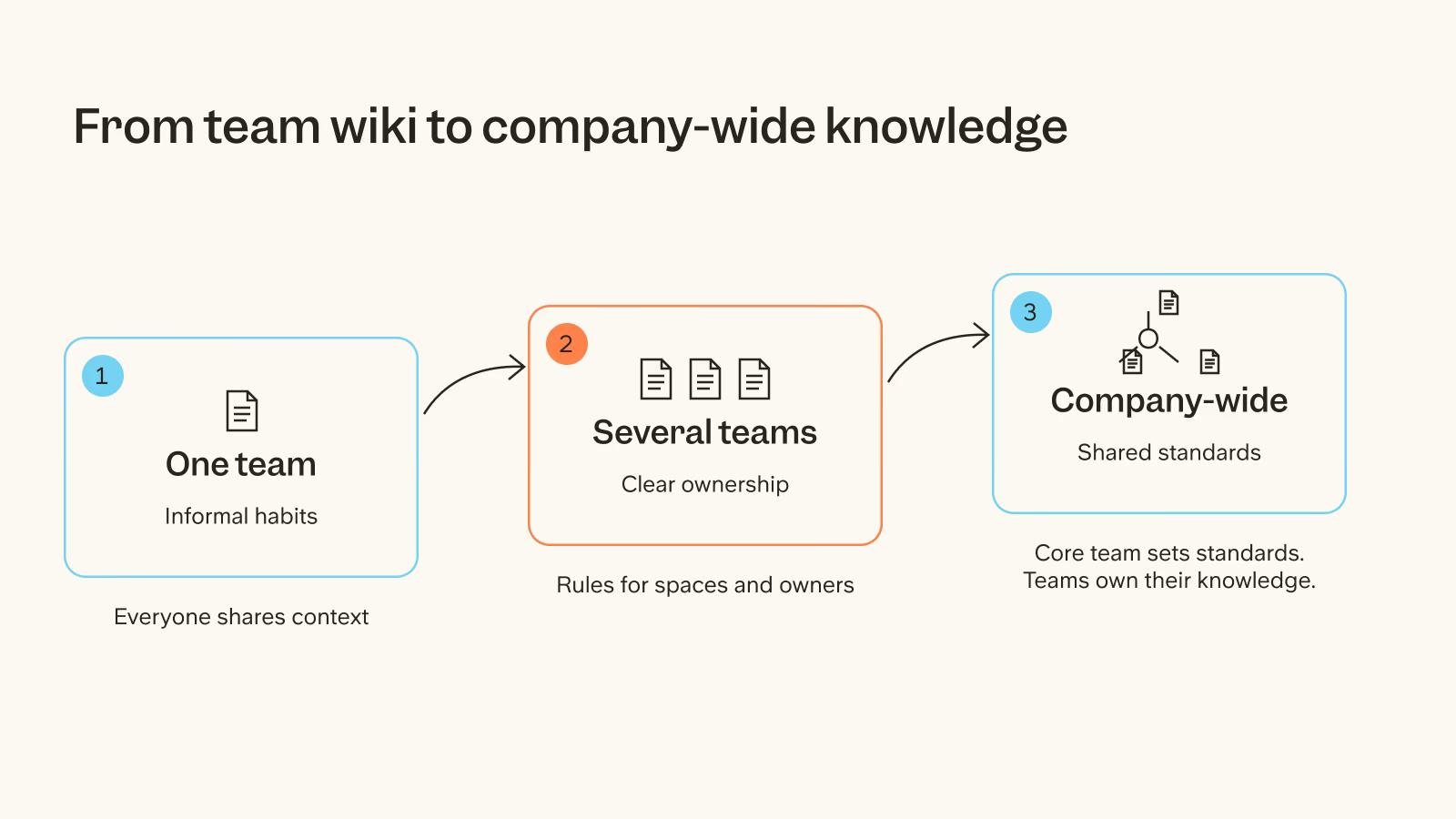
For this guide, we’ll break that growth into three stages: one team using a wiki, several teams depending on the knowledge base, and company-wide use. Each stage changes what you need from the strategy and how formal the governance around it needs to be.
Stage 1: One team has a wiki
When one team uses the company wiki, most decisions can still be handled informally because people generally know what belongs there, who understands each area, and which information needs to stay accurate.
If that describes your current setup, your main priority is to establish some basic habits around what belongs in the wiki and who is responsible for keeping important knowledge trustworthy.
Slite founder Christophe Pasquier recommends aiming for verification across anything considered canonical knowledge, while accepting that most other knowledge does not need the same level of control:
“Anything canonical is worth being verified and I’d aim for 100%. Most of other knowledge does not deserve a badge.”
Stage 2: Several teams depend on the knowledge base
When several teams depend on the knowledge base, the shared context that made the first stage manageable starts to disappear. Departments may organize information differently, create new spaces for different reasons, or have different expectations around who owns what.
At this point, the strategy needs clearer rules around how the knowledge base should grow.
Teams should understand when a new space is justified, what belongs in it, who owns it, and which structural decisions apply across the company.
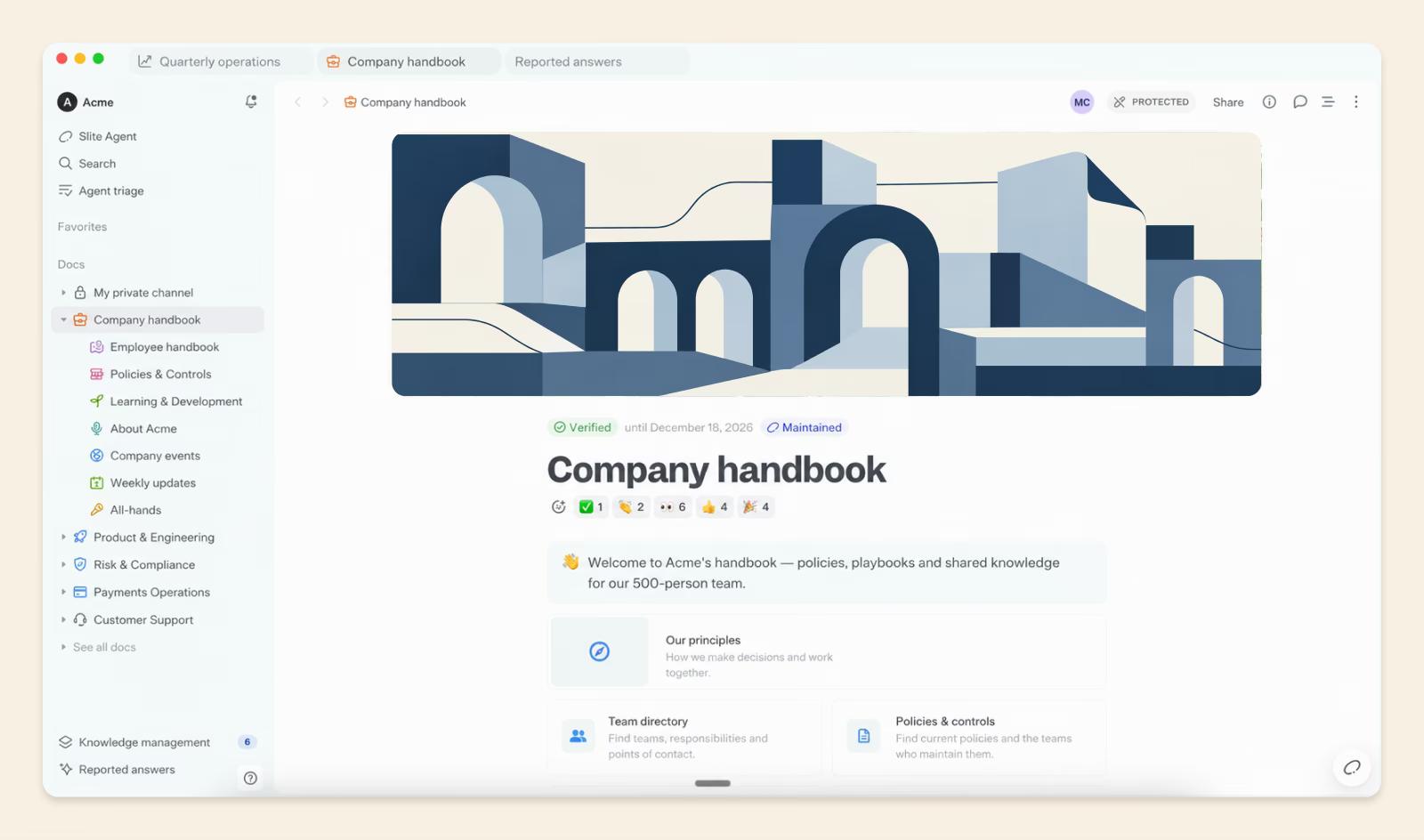
Slite’s customer success playbooks, for example, recommend creating a new space only when it is expected to remain useful for more than a year, keeping the number of top-level docs manageable, and using a Welcome Doc to explain what the space is for.
Stage 3: The knowledge base becomes company-wide
When the knowledge base is used across the company, informal ownership is no longer enough. The company needs clearer coordination around standards, ownership, and decision-making, usually through a knowledge management owner or a small core team.
That team still should not be responsible for maintaining everything itself.
The responsibilities should be distributed across content owners, subject-matter experts, community leaders, champions, and other roles throughout the business.
At this stage, the central team can coordinate the system and set shared standards, while individual departments remain responsible for the knowledge they understand best.
Upvest went through this shift as it grew. Sebastien Jeanquier recalled that when teams were small, “everyone kind of knew what they needed to know,” but the company knew that would not scale.
After rolling Slite out company-wide, Upvest organized its knowledge around team channels, assigned knowledge champions to maintain their domains, and reached 100% company-wide adoption.
How to build a knowledge management strategy
After you know what stage your knowledge base is in, the next step is to build a strategy that fits the way your company actually works. Before adding new rules, roles, or processes, you need to understand what already exists.
1. Audit your current knowledge system
Start by understanding what your company already has before deciding what needs to change. The audit should help you answer five questions:
- Where does company knowledge currently live? List the places employees go for information, including your knowledge base, Slack, Google Drive, project management tools, shared folders, and any team-specific systems.
- Which knowledge do people actually rely on? Identify the documents, spaces, policies, processes, and other information employees regularly need to do their work. This also helps separate important company knowledge (canonical documentation) from notes or documents that do not need the same level of attention (transient documentation).
- Who owns it? Check whether important documents and knowledge areas have clear owners. Flag anything important that has no obvious person or team responsible for keeping it accurate.
- What condition is the knowledge in? Look for outdated information, duplicate documents, empty or abandoned spaces, conflicting versions, and information that is difficult to find.
- Where are employees struggling? Speak to the people using the knowledge base and find out what they cannot find, what they do not trust, and where they still have to ask someone else for an answer. A healthcare company we spoke with had little more than “anecdotal complaints” to understand how its knowledge system was performing, which made it difficult to tell whether the problem was isolated or widespread.
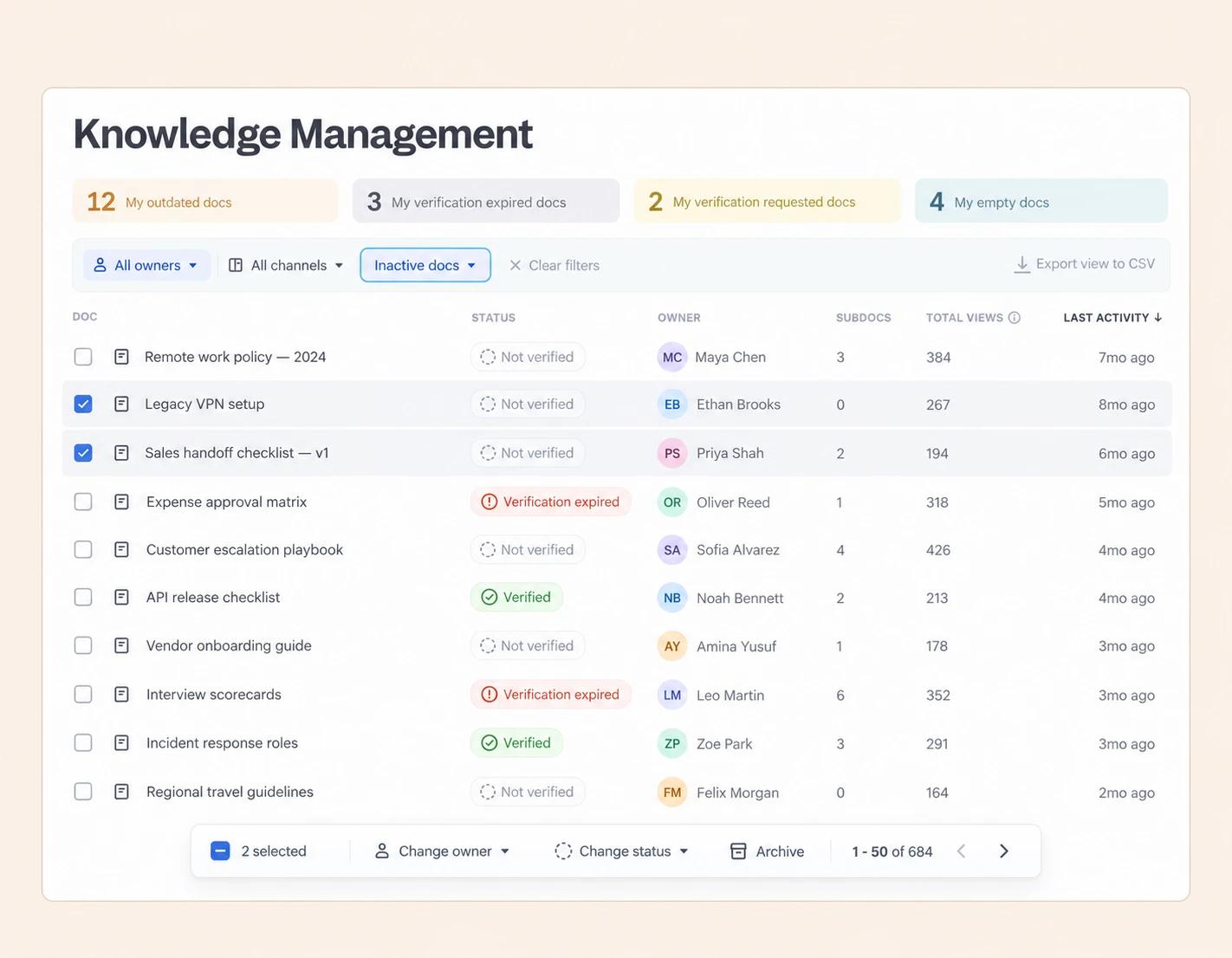
In Slite, the Knowledge Management Panel can help with parts of this audit by surfacing inactive, empty, or unowned documents and making it easier to reassign or clean them up.
At this stage, your focus shouldn’t be on fixing everything immediately, but on understanding the current state well enough to decide what needs attention first.
2. Define your goals and priorities
Use the audit to decide what the strategy needs to improve first. That could mean making important information easier to find, reducing duplicate or outdated documentation, improving ownership, or getting more teams to use the same knowledge base consistently.
Try not to tackle everything at once.
Keeping the priorities narrow makes it easier to assign resources, get teams involved, and tell whether the work is actually improving anything.
Your priorities should also reflect the stage your knowledge base is in.
A smaller team may need to focus on identifying canonical knowledge and assigning owners, while a company-wide system may need clearer governance, stronger adoption across departments, and better ways to measure whether employees can find and trust the information they need.
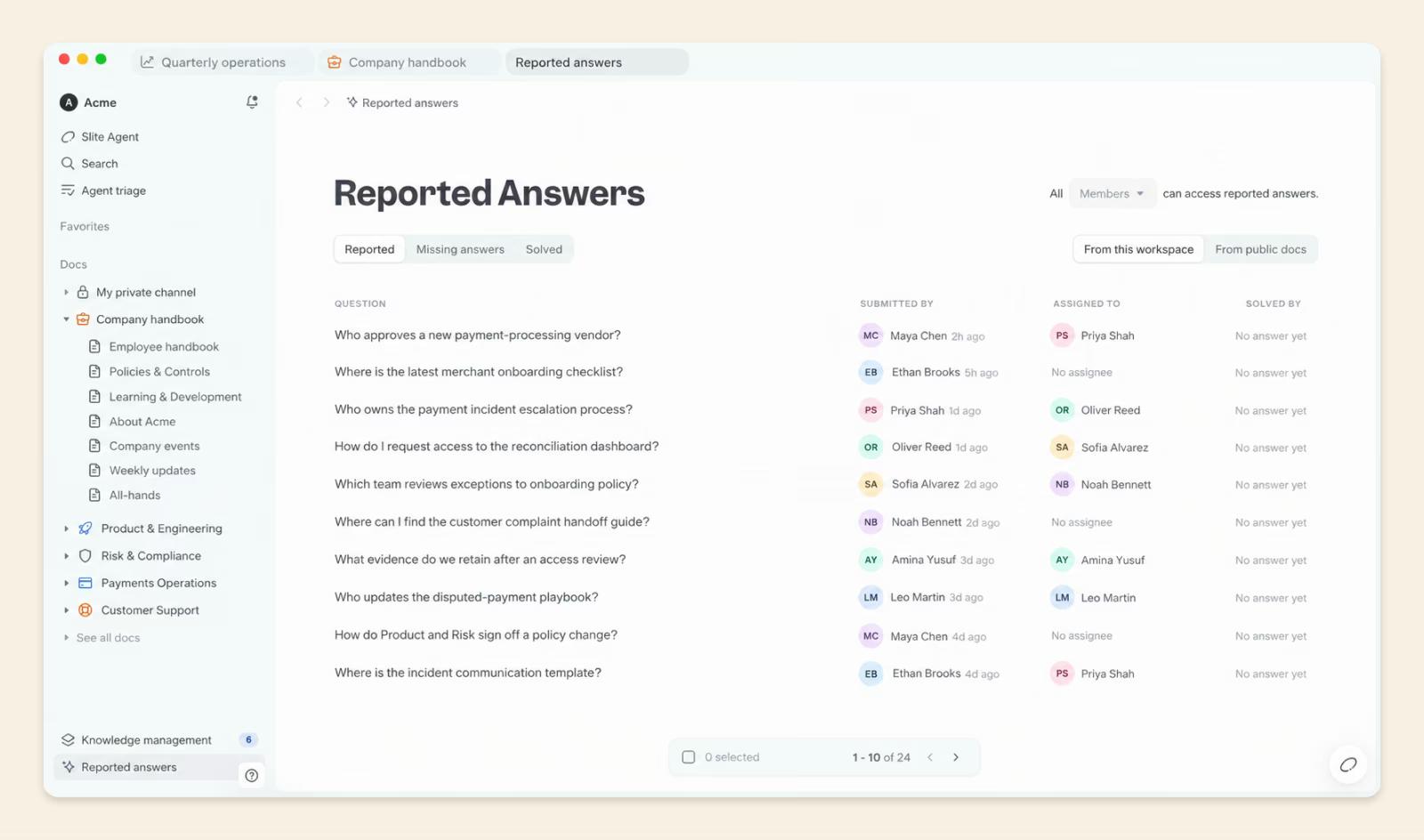
In Slite, Ask Insights can also help you prioritize by surfacing the questions employees are asking that the knowledge base still cannot answer.
3. Define ownership and governance roles
Decide who is responsible for the different parts of the strategy. For companies with 200+ employees, an enterprise-wide governance model is necessary, with a core knowledge management team, a cross-functional steering committee, and defined decision-making responsibilities.
This model also defines roles such as sponsors, subject-matter experts, champions, trainers, and community leaders, which you can map into a simple RACI so everyone knows who is responsible, accountable, consulted, or informed.
Knowledge management often requires teams to change how they document and share information, not just where they store it, so the executive sponsor needs enough authority to remove blockers and keep the strategy moving.
A simple ownership structure could look like this:
- Executive sponsor: backs the strategy, removes blockers, and makes sure knowledge management has the resources and authority it needs.
- Knowledge management owner or core team: coordinates the strategy, standards, rollout, and measurement.
- Domain or team owners: take responsibility for the accuracy and maintenance of knowledge in their areas.
- Subject-matter experts and contributors: create or update the information they know best.
- Champions or trainers: help teams adopt the system and reinforce the agreed ways of working.
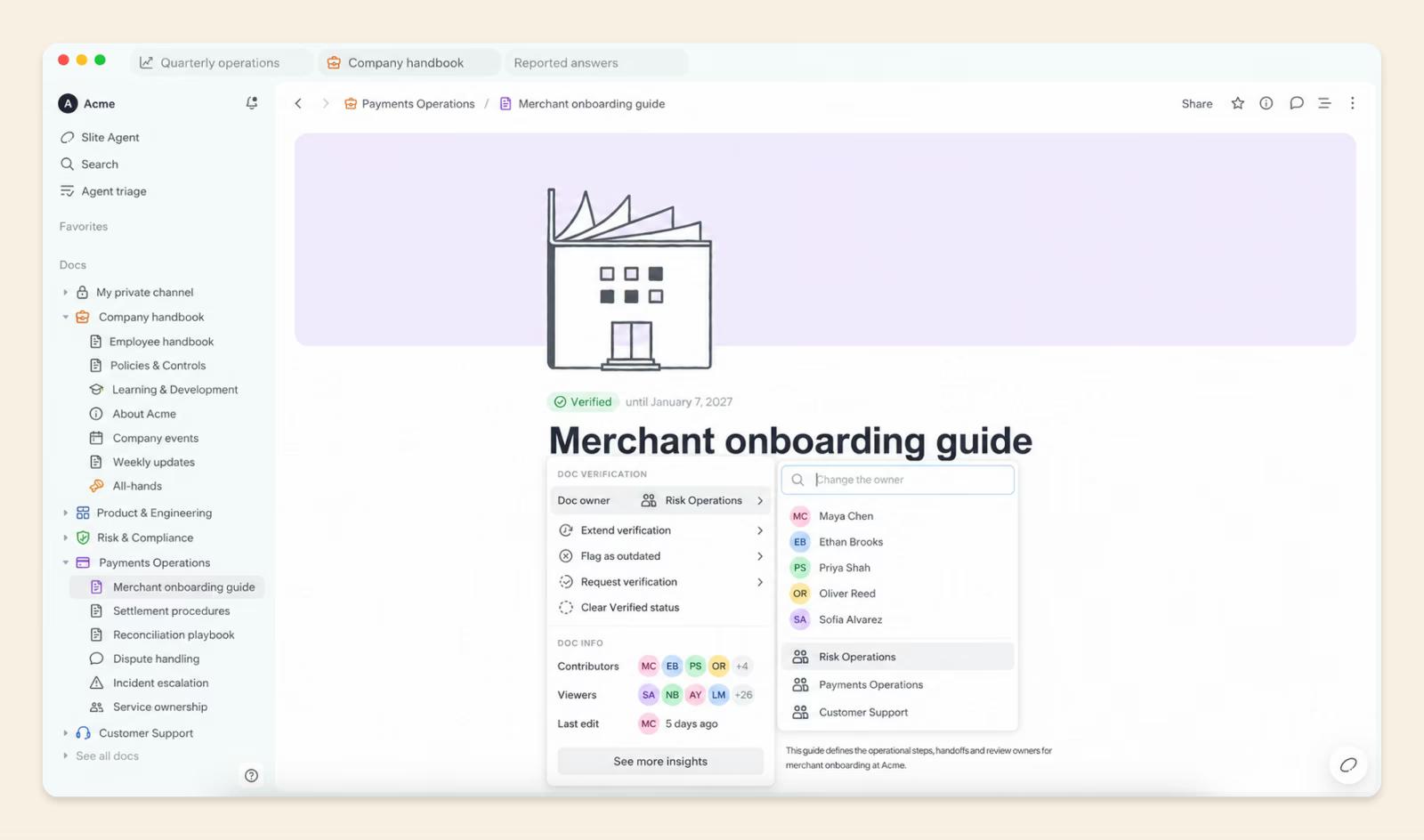
You can use Slite’s user-group ownership to assign responsibility to a team instead of one individual, so ownership does not disappear when someone changes roles or leaves the company.
4. Decide how centralized your governance should be
With the roles clear, decide which knowledge management decisions should sit with a central team and which should stay with individual departments. A fully centralized model gives one team more control over standards and decisions, while a more distributed model gives departments greater responsibility for the knowledge they create and maintain.
We recommend centralizing the standards that need to stay consistent across the organization while distributing ownership of the knowledge itself to the teams closest to it.
For example, Plaid followed a similar pattern when rebuilding its internal documentation. Rather than assigning documents to individual employees, it made teams responsible for ownership and supported that with company-wide expectations:
“We decided that we would disallow individual ownership from inception.”
In Slite, user-group ownership gives you the same team-based model, so responsibility stays with the team even when individual employees change roles or leave.
5. Set the rules for how the knowledge base should grow
Document the basic rules teams should follow when they create, organize, or maintain knowledge. These rules do not need to cover every possible scenario. They should simply remove the decisions that would otherwise be made differently by every team.
Here are some of our recommended rules to apply:
- Create a new channel or space only when it is likely to remain useful for more than a year
- Keep each channel to no more than 10 top-level docs
- Use a pinned Welcome Doc to explain what the space is for and how it should be used
These kinds of rules give teams enough flexibility to manage their own knowledge without letting the overall structure become inconsistent.
Your governance charter should capture those decisions in one place, including:
- When new spaces can be created
- Who can create them
- How they should be named
- Who owns them
- Any standards that apply across the company
In Slite, you can also restrict who is allowed to create channels, which helps enforce those rules instead of relying on everyone to remember them.
6. Plan the rollout
Decide how you will introduce the strategy across the company. You do not need to roll everything out at once. A Slite customer described its approach as “crawl, walk, run, and trust,” starting with a smaller scope before expanding responsibility across more teams.
A simple 30/60/90-day rollout can make that easier to manage:
- First 30 days: finish the audit, agree on priorities, assign owners, and document the basic governance rules.
- Days 31–60: roll the new structure out to a small number of teams, train the people involved, and collect feedback on what is unclear or difficult to follow.
- Days 61–90: adjust the strategy based on what you learned, expand it to more teams, and start measuring adoption and knowledge health consistently.
Give teams enough context to understand why the changes are being made and what is expected of them.
Governance is much harder to sustain when people see it as extra administrative work, so the rollout should make the new responsibilities part of how teams already create, share, and maintain knowledge.
7. Define your success KPIs
Before the rollout is complete, define what success looks like and the KPIs you will use to measure it. Metrics such as participation, satisfaction, business impact, and overall maturity give you a clearer gauge of whether people are simply using the system or whether the strategy is actually improving how knowledge is managed across the company.
Your KPIs should reflect the problems you identified during the audit. We recommend tracking things such as:
- Adoption across teams
- The share of important knowledge with a clear owner
- How much canonical knowledge is verified
- Coverage: whether the knowledge employees need actually exists
- Answer rate: whether employees can get a useful answer when they look for one
- The number of important knowledge gaps that remain
- Overall knowledge health over time
A knowledge lead at one customer uses a five-part knowledge health score to monitor the overall state of the knowledge base. Plaid went further and tracked several indicators after moving its internal documentation to Slite and changing how ownership and verification worked.
About six months later, Plaid saw clear improvements across several measures:
- Median document age: fell from 380 days to 128 days
- Documents older than a year: dropped from 52% to 30%
- Monthly active authors: increased from 65 to 107, a 63% increase
- New documents per month: increased from 58 to 150, a 159% increase
- Verified documentation: grew from almost 0% to around 35%
8. Define how AI fits into your governance model
As AI takes on more of the work involved in creating and maintaining knowledge, your governance model should define what it can do automatically, what still needs human review, and who remains responsible for what ultimately becomes trusted or canonical knowledge.
For example, Gorgias keeps humans responsible for what ultimately becomes trusted knowledge. In our webinar, Yochan Koi, staff engineer at Gorgias, explains that “the ‘Verified’ label implies a human stands behind it,” and that it gives the user a real human to turn to if anything is wrong with the context.
We recommend defining the same kind of boundary, where AI can help create, update, or maintain knowledge, but people remain responsible for what becomes canonical company knowledge.
Slite Agent, for instance, can help your knowledge base stay current while humans remain in charge of what ultimately becomes the source of truth.
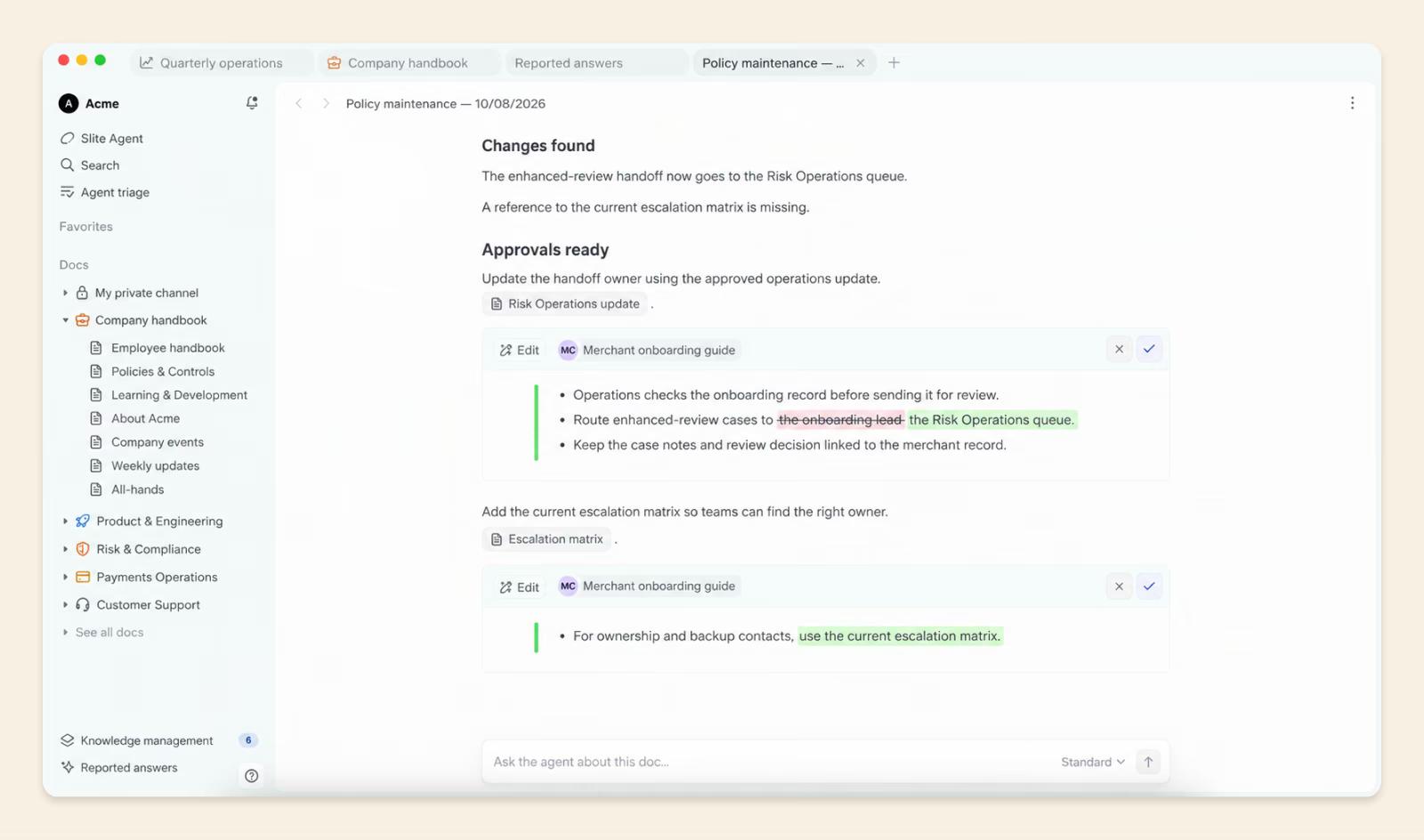
It can help you automatically create new documentation, identify outdated or missing knowledge, compare your docs with information across tools such as Slack, Linear, GitHub, and Intercom, and propose the necessary changes.
Every proposed change then goes through the Triage UI for someone on your team to review before it is applied.
Knowledge management governance vs. information governance
Knowledge management governance defines who owns company knowledge, who makes decisions about it, and how it should be managed. Information governance is broader, covering access, retention, compliance, and security across the organization.
| Knowledge management governance | Information governance | |
|---|---|---|
| Main focus | Keeping company knowledge useful, accurate, and owned | Managing information across the organization |
| Key questions | Who owns this knowledge? Who can make decisions about it? Who keeps it accurate? | Who can access this information? How long should it be retained? How should it be protected? |
| Typical responsibilities | Ownership, decision rights, structure, standards, contribution | Access, retention, security, compliance, records management |
| Who is usually involved | KM owners, team or domain owners, subject-matter experts, contributors | IT, security, legal, compliance, records or data teams |
Knowledge management strategy templates
Here are three free templates to help you document the key decisions in your strategy.
Knowledge management strategy template
Map out your goals, priorities, ownership model, rollout plan, and success measures with the knowledge management strategy template.
Knowledge management governance charter template
Set out the rules, roles, and decision rights for managing knowledge across your company with the knowledge management governance charter template.
Responsible, Accountable, Consulted, and Informed (RACI) template
Clarify who is responsible, accountable, consulted, and informed across your main knowledge management activities with our RACI template.
Build your knowledge management strategy with Slite
Slite gives you the controls to put those ownership, governance, and maintenance decisions into practice:
- Assign ownership to teams so responsibility for important knowledge does not depend on one employee.
- Set guardrails around your knowledge base structure by controlling who can create new channels and documenting how each space should be used.
- Keep canonical knowledge trustworthy with verification and the Knowledge Management Panel, which helps you find outdated, inactive, or unowned content.
- Let Slite Agent help maintain the knowledge base by identifying missing or outdated information and proposing changes, while humans remain in charge of what ultimately becomes the source of truth.
Want to see how this could work for your team? Book a demo for a walkthrough of how knowledge management works in Slite.
FAQ
What is the difference between a knowledge management strategy and a knowledge management plan?
A knowledge management strategy defines the direction, priorities, ownership, governance, and measures for how a company manages knowledge. A knowledge management plan turns that strategy into a documented set of actions, owners, timelines, and metrics.
How often should a knowledge management strategy be reviewed?
Review a knowledge management strategy when the company structure, tools, ownership, or the way teams use knowledge changes significantly. At minimum, revisit it during major growth stages or when rollout data shows that the current rules are no longer working.
Who should approve a knowledge management strategy?
The executive sponsor or leadership team responsible for the program usually approves the knowledge management strategy, while the KM owner or core team develops and coordinates it with input from domain owners.
When does a company need formal knowledge management governance?
A company usually needs more formal knowledge management governance once several departments depend on the same knowledge base and informal decisions around ownership, structure, and standards start creating inconsistencies.